
The Atacama Desert
The driest place on earth runs an improbable variety show: geysers erupting at dawn at El Tatio, flamingos wading salt lagoons, the Valle de la Luna doing its Mars impression at sunset, and — the finale — some of the clearest night skies astronomy has ever pointed a telescope at.
- Best forAdventure seekers · Photographers · Wildlife & nature
- In July21°C · barely any rain
- Ideal stay4–5 nights
- Approx. flying time~10h 20m from Los Angeles
- CurrencyCLPChilean peso
- LanguageSpanish
- Local time09:094h behind the UK
- PlugsType C / LBring an adapter
- Drive on theRightOpposite to the UK
- Dialling code+56
Why go
Between the Andes and the Pacific lies a desert so dry that some weather stations have never recorded rain. The ground shifts from salt crust to red rock to ash-grey volcanic slope, punctuated by lagoons where flamingos feed, geyser fields that erupt at first light and oases where water finally reaches the surface. Nights are cold, the air is thin, and the sky is as clear as anywhere on earth.
Four or five nights based in San Pedro de Atacama covers the main circuits, which agencies run to a fairly standard timetable. It combines naturally with the Bolivian salt flats over the border or a flight south to Patagonia. The desert works year round, though the Bolivian winter brings occasional summer storms. Altitude affects almost everyone, so build the days upward rather than all at once.
- Ideal stay
- 4–5 nights
- The vibe
- Thin-aired, mineral, astonishingly clear
From our guides
Base yourself in San Pedro de Atacama, where every agency sells the same circuits. Altitude is sneaky at 2,400 metres and above, so save the high geysers for day three.
Featured in Ten desert adventures worth the sand in your boots
Things to do
-
El Tatio geysers
A high geothermal field at around 4,300 metres, most active at dawn when the steam columns show best. Departures are very early and very cold.
-
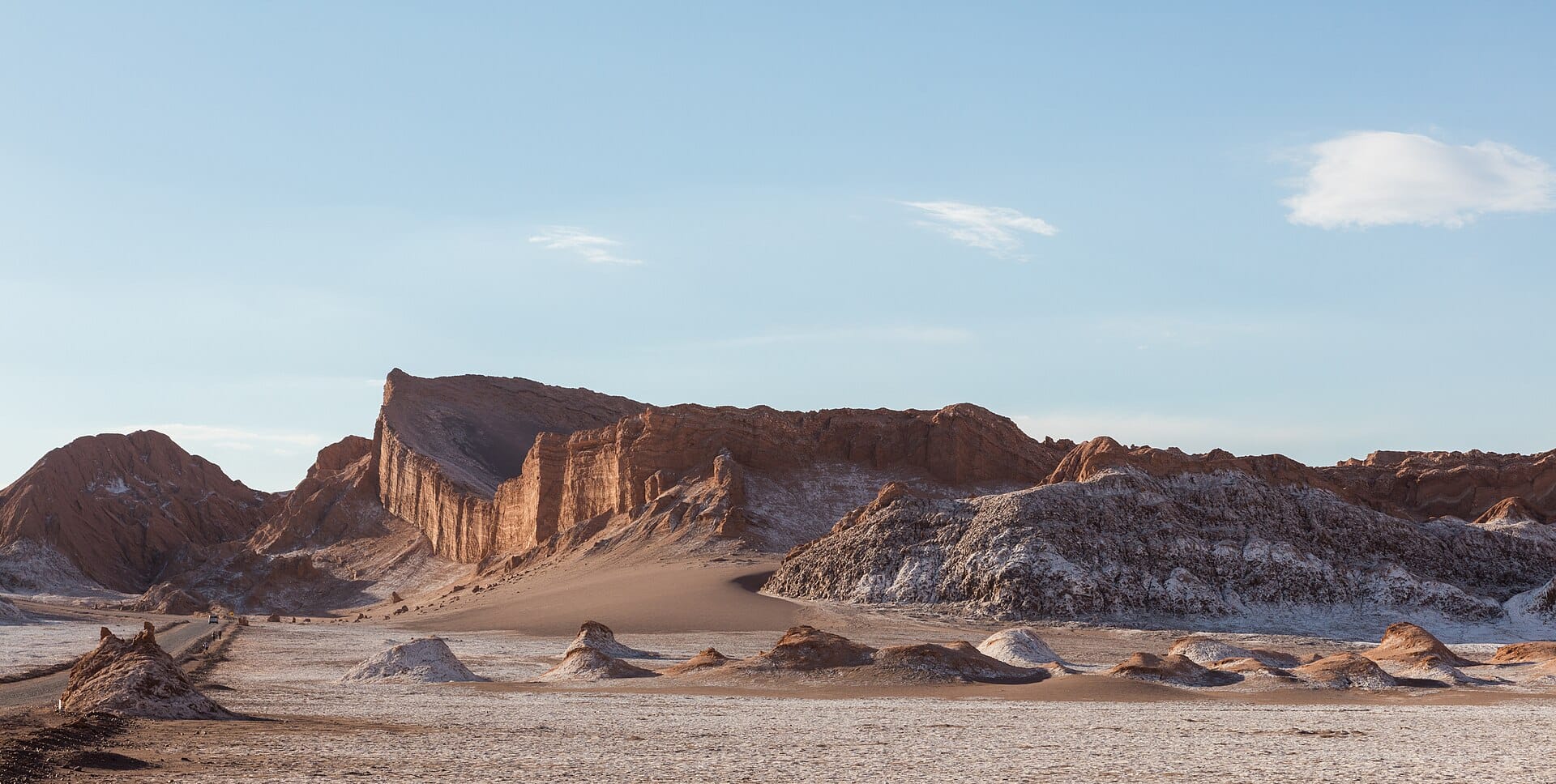
Valle de la Luna
Salt-carved ridges and dunes just outside San Pedro, best at sunset when the rock turns red and the Andes glow across the valley.
-
Laguna Chaxa
A salt-flat lagoon in the Los Flamencos reserve where three flamingo species feed, with the cone of Licancabur behind.
-
Stargazing
Dry air and altitude make this one of the world's leading astronomical regions. Small observatories run public sessions on moonless nights.
-
Altiplanic lagoons
Miscanti and Miniques sit above 4,000 metres, deep blue against pale volcanic slopes, usually combined with the salt flat in one long day.
-
Puritama hot springs
A chain of warm pools in a canyon north of San Pedro, terraced and boardwalked, and the standard recovery after a geyser morning.
Getting there
-
Fly to
Calama (CJC)
Nearest airport to Atacama Desert, about 235km away as the crow flies.
-
Then
To San Pedro de Atacama
Most visitors fly into Calama (CJC), about an hour and a half east by shuttle or transfer to San Pedro de Atacama. Antofagasta (ANF) is a longer haul of roughly four to five hours by road.
-
On the ground
Getting around
San Pedro is a small grid of dirt streets you cross on foot in ten minutes. Every excursion, the El Tatio geysers, the Valle de la Luna, the altiplano lagoons and the stargazing, is sold as a guided trip with transport included.
Public transport: Long-distance buses reach San Pedro from Calama and Salta, but nothing scheduled runs to the sights themselves.
Flights
Los Angeles Atacama Desert, Chile
Fly from anywhere — search 4,000+ airports worldwide.
Roughly 10h 20m in the air from Los Angeles (LAX), estimated from the distance — check for a direct route. Pick a month to see every available flight with live prices.
Check dates and prices
Pick your departure date, then your return.
Search flightsNot sure when? Compare fares across a whole month.
Flight times are estimates; prices open on Google Flights.
When to go
Daytime highs run from about 21°C in June to 27°C in January. Rain is rare in any month.
The year at a glance — pick a month for detail
July21° · no rainMild and dry.
Monthly figures averaged from daily records for 2020–2024 at this location (ERA5 reanalysis). Live conditions from MET Norway, CC BY 4.0.
Where to stay
Adobe-walled lodges and small hostales in San Pedro, a few all-inclusive desert hotels that bundle their own excursions, and basic hostels. No chains and few large hotels.
-
Best base overall
San Pedro de Atacama
Every tour, agency and restaurant is in these adobe lanes, and you can walk the lot in ten minutes. Prices are high for Chile and the nights are genuinely cold.
Find stays in San Pedro de Atacama -
Best for couples
The Ayllu de Solcor and Coyo outskirts
Irrigated hamlets a short walk or cycle from the centre, with quiet adobe lodges and clear sky overhead. You will trek into town for dinner and tour pick-ups.
Find stays in The Ayllu de Solcor and Coyo outskirts -
Best value
Calama
The mining city by the airport, with ordinary business hotels at a fraction of San Pedro prices. It is an hour and a half away and has no atmosphere whatsoever.
Find stays in Calama -
Quietest
Toconao
A small village further down the salt flat road, with a handful of simple guesthouses and almost no visitors after dark. Tours mostly start in San Pedro, so transfers add up.
Find stays in Toconao
Worth knowing before you book: Rooms are limited and January, February and the Chilean holidays sell out well ahead. Heating and hot water vary a lot, so check both before booking in winter.
Search everything else in San Pedro de Atacama by budget. These are indicative budget bands in GBP per night for two people, not live quotes or guarantees of hotel type. Check your dates, guests, taxes and final price on Booking.com.
Good to know
- Altitude
- San Pedro sits at about 2,400 metres and tours climb well above 4,000. Take the first day easy, drink plenty and save the geysers for later in the trip.
- Temperature
- Days are hot and nights close to freezing. Layers, a warm hat and gloves matter as much as sun protection.
- Cash or card
- San Pedro has few ATMs and they run dry in season. Bring Chilean pesos in cash for tours, entry fees and smaller restaurants.
- Book ahead
- Accommodation and the better-run tours sell out over the Chilean summer and public holidays. Reserve stargazing before you arrive.
- Sun
- There is almost no cloud and very little shade. High-factor sunscreen, sunglasses and a brimmed hat are essential every day.
Similar places
Further afield

Related articles
Quick answers
When is the best time to visit The Atacama Desert?
Daytime highs run from about 21°C in June to 27°C in January. Rain is rare in any month.
How long should I spend in The Atacama Desert?
Our suggestion: 4–5 nights.
How do I get to The Atacama Desert?
Most visitors fly into Calama (CJC), about an hour and a half east by shuttle or transfer to San Pedro de Atacama. Antofagasta (ANF) is a longer haul of roughly four to five hours by road.
Do I need a car in The Atacama Desert?
No. Long-distance buses reach San Pedro from Calama and Salta, but nothing scheduled runs to the sights themselves.
What currency and language are used in The Atacama Desert?
Currency: Chilean peso (CLP). Language: Spanish. Plugs: type C and L.
Who is The Atacama Desert best for?
Best for adventure seekers, photographers and wildlife & nature. In a phrase: thin-aired, mineral, astonishingly clear.