
Salar de Uyuni
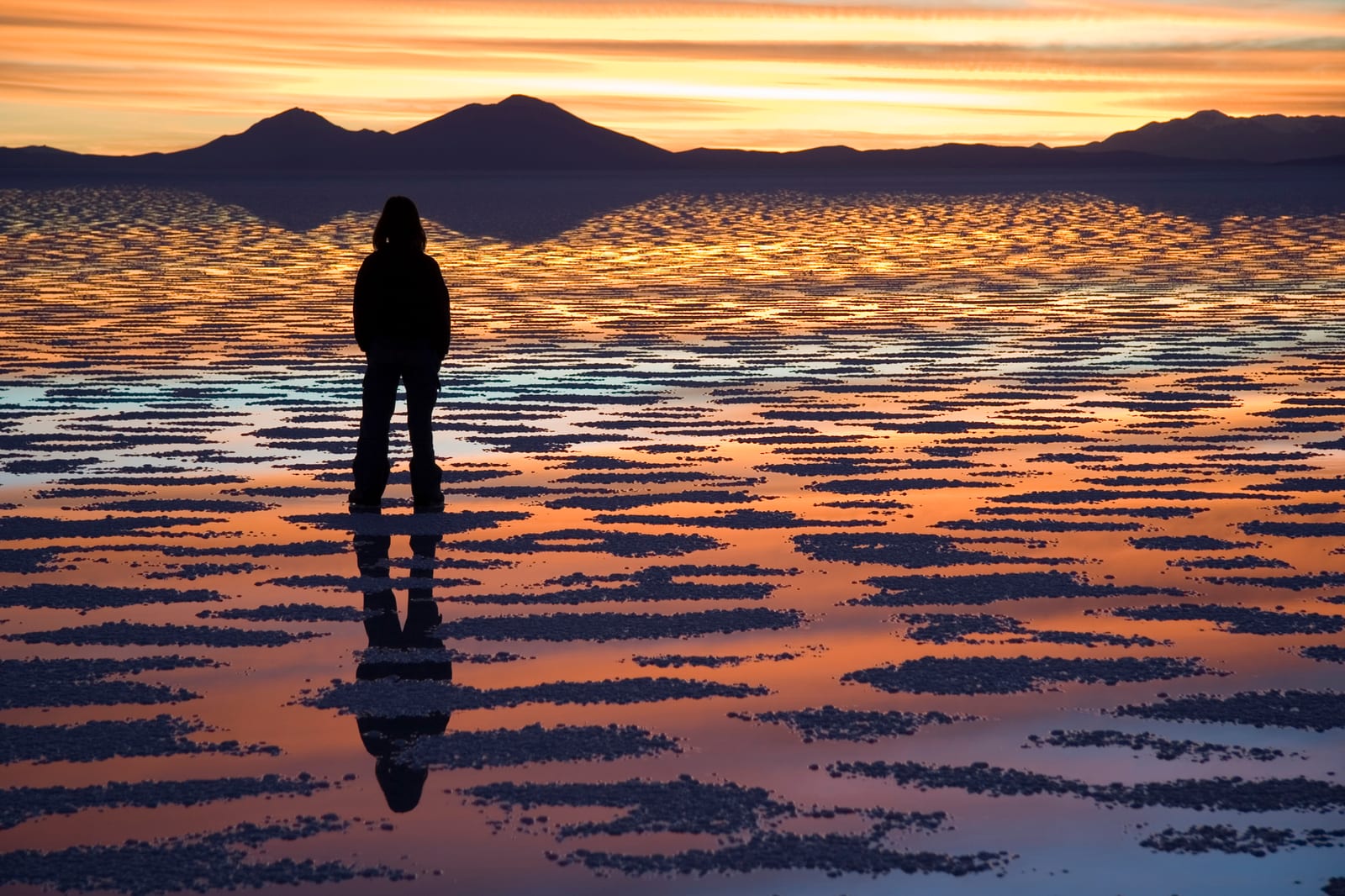
The world's largest salt flat plays two roles: in the dry season, a blinding white geometry of hexagons stretching past the curvature of the earth; after rain, December to March, a mirror so perfect that 4x4s appear to drive across the sky.
- Best forAdventure seekers · Photographers · Road-trippers
- In April17°C · barely any rain
- Ideal stay3 days
- Approx. flying time~10h 15m from Los Angeles
- CurrencyBOBBolivian boliviano
- LanguageSpanish
- Local time07:115h behind the UK
- PlugsType A / CBring an adapter
- Drive on theRightOpposite to the UK
- Dialling code+591
Why go
Scale is the difficulty here. The flat covers more than 10,000 square kilometres with no reference points at all, so distance and size stop making sense, which is exactly why the trick photographs work. Beyond the salt itself the standard route crosses a high desert of coloured lagoons, volcanoes, geyser fields and hot springs near the Chilean border, staying above 4,000 metres for days.
Most people join a 4x4 tour from Uyuni or Tupiza, sleeping in basic refuges, and many finish at the Chilean border for onward travel to San Pedro de Atacama. Give yourself two or three days in La Paz, Sucre or Potosi first to acclimatise. Nights drop well below freezing between June and August. This is not a comfortable trip, and nobody should pretend otherwise.
- Ideal stay
- 3 days
- The vibe
- Blinding, empty, high and strange
From our guides
Standard three-day tours from Uyuni add flamingo-flecked lagoons and a night in a hotel built entirely of salt. At 3,650 metres the altitude is real, so arrive acclimatised from La Paz or Sucre. Sunglasses are non-negotiable; the glare is biblical.
Featured in Ten desert adventures worth the sand in your boots
Things to do
-
Isla Incahuasi
A rocky outcrop in the middle of the flat, covered in giant cactus several metres tall and fossil coral. Climbing it gives the only high vantage point for miles.
-
Laguna Colorada
A shallow red lake stained by algae and minerals, with thousands of James's and Andean flamingos feeding in it, at around 4,300 metres.
-
Sol de Manana geysers
A geothermal field of mud pots and steam vents visited before dawn, when cold air makes the plumes visible. The ground is unstable, so stay with the guide.
-
Termas de Polques
Hot springs beside a lagoon where tours stop for a soak at sunrise. Keep swimwear accessible in your bag rather than buried in the roof rack.
-
Train cemetery
Rusting steam locomotives sit on the salt outside Uyuni, abandoned when the mining lines closed. Usually the first stop of any tour.
-
Arbol de Piedra
A wind-carved rock in the Siloli desert, balanced on a narrow stem and surrounded by red sand and volcanoes. The landscape here looks closer to Mars.
Getting there
-
Fly to
Quijarro (UYU)
Nearest airport to Salar de Uyuni, about 73km away as the crow flies.
-
Then
To Uyuni
Uyuni (UYU) is about ten minutes from town and takes daily flights from La Paz; the overnight bus, or the train from Oruro, is the usual alternative.
-
On the ground
Getting around
Tours leave Uyuni in 4x4s with a driver and cover the flats and the southern lagoons over one to three days. Driving yourself on the salt is not sensible.
Public transport: Buses connect Uyuni with La Paz, Oruro, Potosi and Sucre, but the salt flat itself is only reached on an organised tour.
Flights
Los Angeles Salar de Uyuni, Bolivia
Fly from anywhere — search 4,000+ airports worldwide.
Roughly 10h 15m in the air from Los Angeles (LAX), estimated from the distance — check for a direct route. Pick a month to see every available flight with live prices.
Check dates and prices
Pick your departure date, then your return.
Search flightsNot sure when? Compare fares across a whole month.
Flight times are estimates; prices open on Google Flights.
When to go
Daytime highs run from about 11°C in June to 19°C in November. Driest April to October; wettest in February, with rain on about 13 days.
The year at a glance — pick a month for detail
April17° · rain 1 dayCool and dry.
Monthly figures averaged from daily records for 2020–2024 at this location (ERA5 reanalysis). Live conditions from MET Norway, CC BY 4.0.
Where to stay
Budget hostels and small hotels in Uyuni, plus salt built hotels along the flat's edge. Most visitors sleep in basic refuges arranged as part of a three day tour, not booked separately.
-
Best base overall
Uyuni
A blunt, cold railway town where every tour starts, with hostels, simple hotels and a long row of agency offices. Nobody comes for the town, but the logistics all live here.
Find stays in Uyuni -
Closest to the sights
Colchani
The salt processing village at the edge of the flat, where the hotels built of salt blocks stand. Sunrise on the salt is minutes away, though facilities are basic and nights are freezing.
Find stays in Colchani -
Quietest
Tahua
On the flat's northern shore beneath a volcano, with a few small lodges used by tours running the longer route. Remote, dark and utterly silent, with no services at all.
Find stays in Tahua
Worth knowing before you book: Choose the operator rather than the bed, as accommodation is bundled into the tour. December to March gives the mirror but floods some routes, and nights drop below freezing year round.
Search everything else in Uyuni by budget. These are indicative budget bands in GBP per night for two people, not live quotes or guarantees of hotel type. Check your dates, guests, taxes and final price on Booking.com.
Good to know
- Altitude
- The flat sits at 3,650 metres and the route climbs higher. Arrive already acclimatised, drink water constantly and skip alcohol for the first days.
- Pack this
- Sunglasses, high-factor sun cream, lip balm, gloves and a hat. Glare off white salt is severe and nights fall well below freezing.
- Timing
- The mirror effect needs standing water and appears roughly December to March. The dry season from May to October gives firmer ground and fuller access.
- Cash or card
- Bring bolivianos in cash. Card machines are unreliable in Uyuni and absent on the route, and park entry fees are cash only.
- Book ahead
- Choose an operator on safety record rather than price, and ask about vehicle age, seat belts and radios. Accidents on this route are not unknown.
Similar places
Further afield

Related articles
Quick answers
When is the best time to visit Salar de Uyuni?
Daytime highs run from about 11°C in June to 19°C in November. Driest April to October; wettest in February, with rain on about 13 days.
How long should I spend in Salar de Uyuni?
Our suggestion: 3 days.
How do I get to Salar de Uyuni?
Uyuni (UYU) is about ten minutes from town and takes daily flights from La Paz; the overnight bus, or the train from Oruro, is the usual alternative.
Do I need a car in Salar de Uyuni?
No. Buses connect Uyuni with La Paz, Oruro, Potosi and Sucre, but the salt flat itself is only reached on an organised tour.
What currency and language are used in Salar de Uyuni?
Currency: Bolivian boliviano (BOB). Language: Spanish. Plugs: type A and C.
Who is Salar de Uyuni best for?
Best for adventure seekers, photographers and road-trippers. In a phrase: blinding, empty, high and strange.