Car hire
Exploring beyond Rotorua is easiest with your own wheels — compare prices for Rotorua:
Car hire in RotoruaNew Zealand's geothermal heartland steams, bubbles and occasionally erupts around a lakeside town that smells faintly of sulphur and doesn't apologise.
Geothermal activity is not a sight here, it is the background: steam rising from drains and parks, mud pools in the middle of town, and a smell of sulphur you stop noticing by day two. The lakes around it are large, cold and quiet, the forest is redwood and fern, and a strong Te Arawa Maori presence shapes much of what visitors actually do.
Three nights covers the geothermal parks, a cultural evening and a forest day, and it sits within easy reach of Taupo, Waitomo and the Bay of Plenty on a North Island road trip. Winter is cool and clear and makes the hot pools better, while summer brings the crowds and the lake swimming. Anyone sensitive to sulphur smells should adjust their expectations accordingly.
From our guides
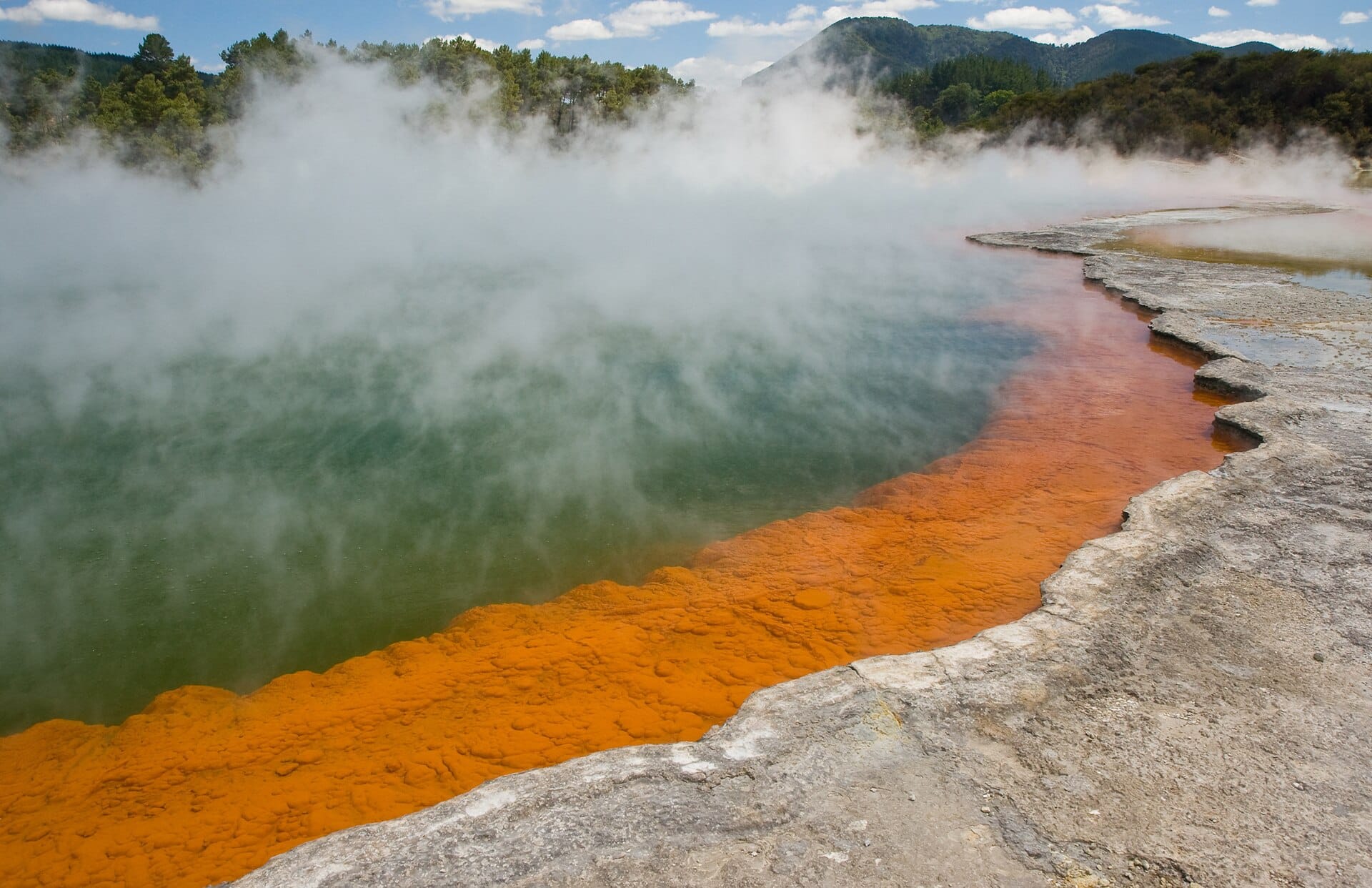
Soak in the Polynesian Spa's lakeside pools as black swans drift past, then day-trip to Wai-O-Tapu, where the Champagne Pool rims orange like a science-fiction cocktail. Book an evening at a Māori cultural village for a hāngī feast. Go in the southern winter, June to August, when the cool air makes the hot pools sing.
Featured in Ten spa and hot-spring escapes to switch off together
A Maori village built among geysers and steam vents, where residents still cook in boiling pools. Guided by the people who live there, beside the Pohutu geyser.
Californian redwoods planted a century ago, with mountain-bike trails, walking tracks and a treetop walkway strung between the trunks. Parts of it are lit at night.
The valley created by the 1886 Tarawera eruption, walked downhill past a steaming crater lake. Younger and far less busy than the better-known parks.
The mountain split open in 1886 and the scar is still raw. Boats cross the lake to hot springs on the far shore, reachable only by water.
The most active of the accessible geothermal parks, with a mud bath and sulphur spa alongside the walking circuit. Steam, noise and heat at close range.
The inflatable downhill ball was invented here and is still running, along with a gravity luge reached by gondola above the lake. Undignified and good fun.
Nearest airport to Rotorua, about 6km away as the crow flies.
About 10 minutes by taxi or shuttle from Rotorua (ROT) into town; many visitors instead drive the three hours down from Auckland.
The lakefront and Government Gardens are walkable, but Wai-O-Tapu is roughly half an hour south and the redwoods, buried village and Maori villages are spread around the lakes.
Public transport: A local bus network covers the town and some attractions, and tour shuttles run out to the geothermal parks.
Exploring beyond Rotorua is easiest with your own wheels — compare prices for Rotorua:
Car hire in RotoruaLos Angeles Rotorua, New Zealand
Fly from anywhere — search 4,000+ airports worldwide.
Roughly 13h in the air from Los Angeles (LAX), estimated from the distance — check for a direct route. Pick a month to see every available flight with live prices.
Pick your departure date, then your return.
Search flightsNot sure when? Compare fares across a whole month.
Flight times are estimates; prices open on Google Flights.
Daytime highs run from about 12°C in July to 23°C in January. Driest February to May; wettest in November, with rain on about 14 days.
The year at a glance — pick a month for detail
January23° · rain 11 daysMild with rain most weeks.
Monthly figures averaged from daily records for 2020–2024 at this location (ERA5 reanalysis). Live conditions from MET Norway, CC BY 4.0.
Motels with private thermal pools, lakeside lodges, holiday parks and a few international hotels in town. Self catering is common, and some Maori villages offer overnight cultural stays.
Walkable to the geothermal parks, the museum gardens and the restaurants on Eat Streat, with the lake at the end of the road. The sulphur smell is strongest here.
Find stays in Rotorua lakefront and centreOn the lake's western shore near the farm show, the gondola and the trout springs, with motels and holiday parks. Everything needs a short drive, but parking is free.
Find stays in NgongotahaThe long motel strip running south from town, plain but cheap, with kitchenettes and easy parking. Some units have their own thermal pools, which is the local party trick.
Find stays in Fenton StreetTwenty minutes east among the bush, with lodges and holiday houses facing the water and the Buried Village nearby. No shops, no restaurants, and phone signal comes and goes.
Find stays in Lake TaraweraWorth knowing before you book: New Zealand school holidays and summer weekends fill the motels, and a mineral pool in the room is worth booking specifically. Winter is cheaper and better for the hot pools.
Search everything else in Rotorua by budget. These are indicative budget bands in GBP per night for two people, not live quotes or guarantees of hotel type. Check your dates, guests, taxes and final price on Booking.com.
Daytime highs run from about 12°C in July to 23°C in January. Driest February to May; wettest in November, with rain on about 14 days.
Our suggestion: 3 nights.
About 10 minutes by taxi or shuttle from Rotorua (ROT) into town; many visitors instead drive the three hours down from Auckland.
Yes, a car makes a real difference here. A local bus network covers the town and some attractions, and tour shuttles run out to the geothermal parks.
Currency: New Zealand dollar (NZD). Language: English and Māori. Plugs: type I.
Best for couples, families and wellness & slow travel. In a phrase: steaming, sulphurous, culturally rich.